
How to Protect Your Garage Door from Break-Ins During Summertime
Summer means more vacations, longer daylight, and garages left open longer. While our technicians won’t say break-ins spike in summer specifically, all of that does create more opportunities for something to go wrong. Lock your opener, secure the emergency release, and check your sensors before the season gets busy.
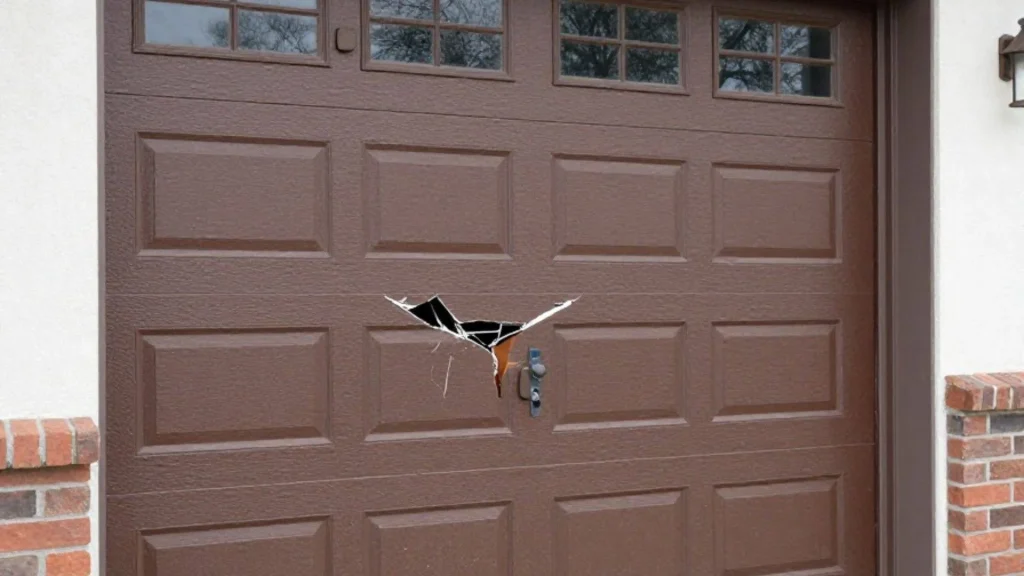
Break-and-enters aren’t rare in this province. Ontario’s property crime rate sits at roughly 2,000 incidents per 100,000 people, and Toronto alone logged just over 6,000 break-ins in 2025, more than 16 a day. Some regions are trending the wrong way: break and enters in Halton climbed from 655 in 2020 to 1,061 in 2024.
Summer adds fuel to that. More vacations, longer daylight, and garages left open longer all give burglars more chances. Even without a hard seasonal spike, summer is when Vitas techs see the most wear-related service calls, since doors get used more often.
A garage door that’s already worn or poorly maintained is more likely to fail to close or lock properly right when you need it to.
Keep reading to learn six ways to protect your garage door and home this summer:
Key Takeaways:
- Close the garage door whenever you can’t see it. The simplest summer risk is an open door, not a clever break-in method.
- Never zip-tie the emergency release cord. It can trap the mechanism you’d need in a real emergency. Use a purpose-built release shield instead.
- Confirm your opener uses rolling code, not a fixed signal that can be recorded and replayed. Vitas techs still find fixed-code openers in older homes that haven’t been upgraded.
- A compatible manual or automatic lock adds a real second layer for extended absences, but never run the opener while it’s engaged.
- Test your safety sensors monthly, not just before a trip. A failing sensor can leave the door stuck open and low-angle summer sunlight is a common trigger.
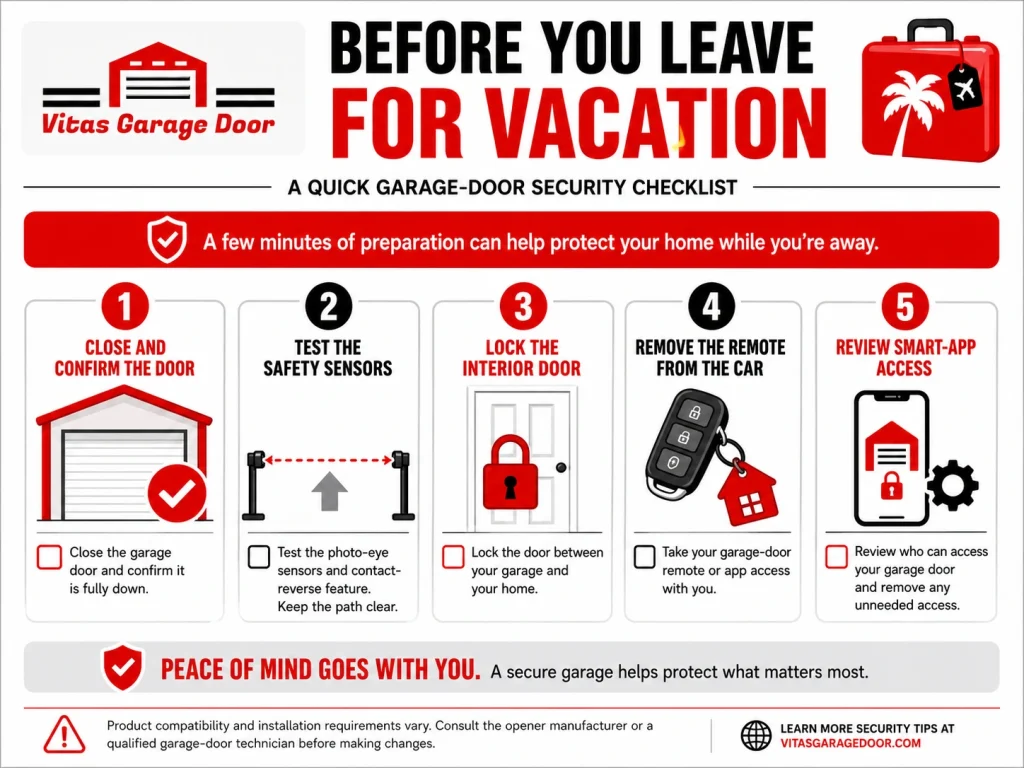
- Don’t leave your remote in the car. Switch to a keychain remote, keypad, or app, and keep the interior garage-to-house door locked regardless.
- Book a pre-summer inspection. Most garage door problems show up quietly first, before they become a security risk or a bigger repair.
Keep the Door Closed, and Secure the Emergency Release
The simplest risk in summer isn’t clever, it’s just an open door. Close it whenever you step away from the driveway or lose sight of it.
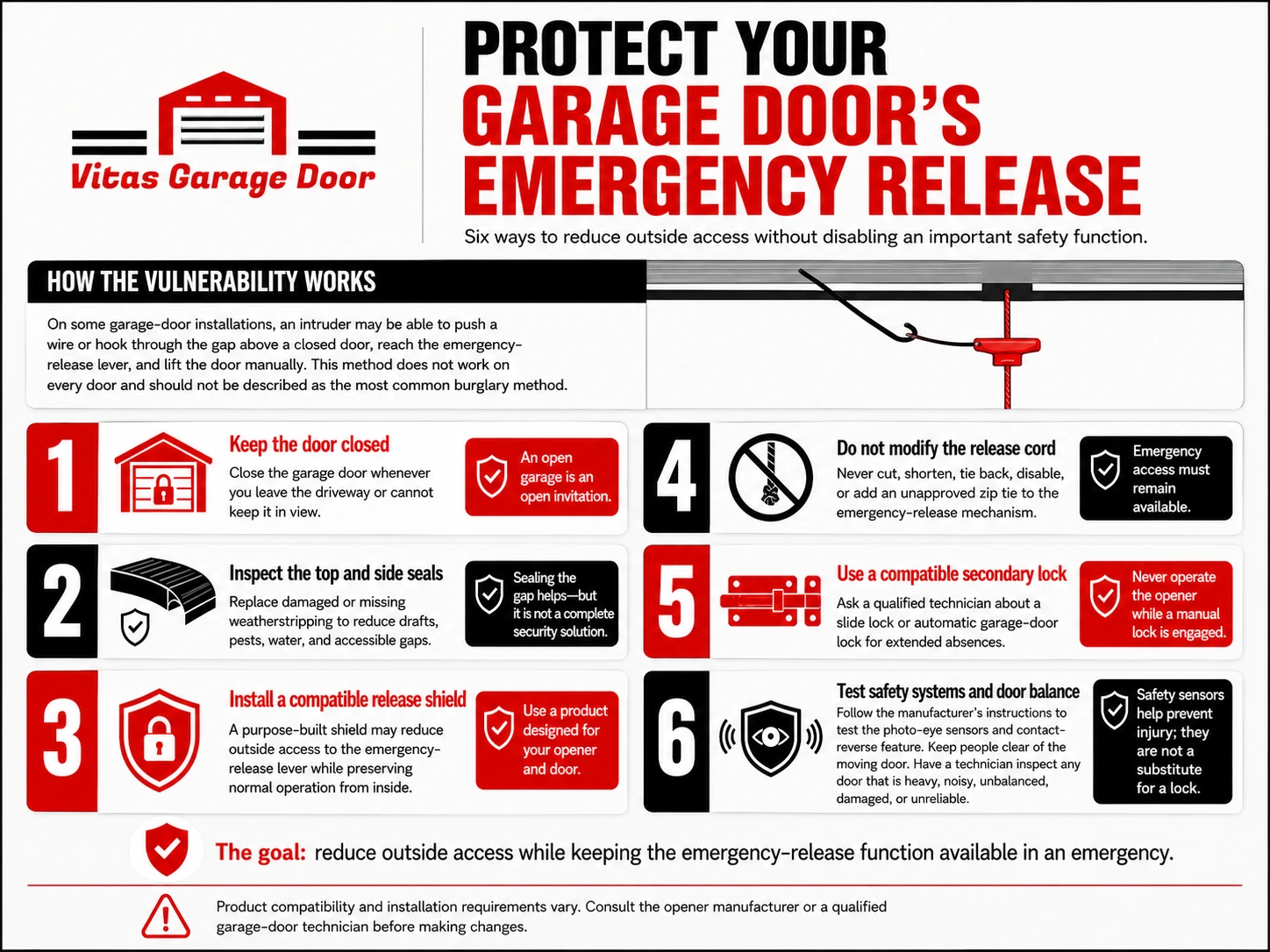
The emergency release cord is a second, more talked-about vulnerability on some attached garages. It’s the red handle near your garage door opener, there to manually disconnect the door during a power outage. In some cases, a small gap above a closed door is enough for someone to reach that lever from outside and lift the door by hand.
This is one of the most common issues Vitas technicians flag on older Ontario garages: a reachable emergency release paired with aging door hardware, worn rollers and hinges, or damaged weather seals that widen the gap at the top of the door.
How to secure it:
Never cut, remove, or disable the release cord. Have a garage door technician install a purpose-built release shield or a manufacturer-compatible guard, something that blocks outside access without disabling the release from inside.
💡 Safety note: Never use a zip tie on the emergency release. While a zip tie may seem like a quick way to prevent an outside break-in, it can restrict the emergency-release mechanism inside the garage. That release is designed to let people disconnect the opener quickly if someone becomes trapped, the opener fails, or the door must be moved manually. In an emergency, fumbling with or breaking a zip tie may take too much time or force.
Confirm Your Opener Uses Rolling Code
One way thieves break into garages is by stealing the signal your remote sends to open the door. A small handheld device can record that signal while you’re nearby. Later, they replay the recording and the door opens. No key. No tools. No sign of forced entry.
This works because of how your opener’s code is set up:
- A fixed-code opener sends the exact same signal every time you press the remote. That signal never expires, so a recorded copy still works whenever someone plays it back.
- A rolling code opener sends a new signal every time. A recorded signal is useless after that one use.
Fixed-code openers are far less common than they used to be, but Vitas technicians still come across them, especially in older homes where the opener has never been replaced.
Most date back to opener generations built before rolling-code technology became standard. If a technician finds one, the usual recommendation is to upgrade it rather than keep relying on outdated security.
Technician’s tip:
Check the model number and owner’s manual, or have a garage door technician confirm it next time they’re out. Rolling code protects against signal replay specifically, but it won’t help if a remote is stolen or a smart-home account gets compromised, so think of it as one layer, not the whole fix.
Learn more: What Does It Cost to Fix a Broken Garage Door Spring in Toronto?
Get a Compatible Lock for Extended Absences
The photo-eye sensors near the bottom of your tracks are there to stop the door from closing on a person, pet, or object. If sensors are misaligned or failing, the door might refuse to close or reverse unexpectedly, and that leaves the garage exposed while it’s stuck open.
Summer heat itself isn’t usually the culprit behind sensor problems. It’s the strong, low-angle sunlight that can hit the receiving photo-eye sensor and interfere with the infrared beam.
One of the most common calls Vitas technicians get is some version of “the door works fine in the morning but won’t close in the afternoon,” which is often a sign that sunlight is hitting the sensor at a specific time of day. Misalignment, dirt, bumped brackets, and damaged wiring are just as common as sunlight and worth ruling out too.
How to test them:
While the door is closing, interrupt the beam with a long-handled object, staying clear of the door itself. It should stop and reverse to fully open. Once a month, run the manufacturer’s contact-reverse test too, usually a 2×4 laid flat on the floor. The door should reverse the moment it touches it.
Test Your Safety Sensors Before You Leave
A manual or automatic lock adds another layer of protection for when you’re away for more than a day or two, on top of whatever your opener already handles. While some openers already lock automatically, a separate lock is useful in case it fails or is bypassed.
That said, the lock (a slide bolt, basically) only helps if it’s actually compatible with your specific door and opener.
How to secure it:
Ask a technician whether your setup supports a manual lock or would benefit from an automatic one. Cost and install time depend on the product and door, so treat any figure here as a starting point to confirm, not a quote.
Treat Your Opener Remote Like a House Key
A remote sitting in a parked car is basically a spare key to your garage. Whether that risk reaches your actual home depends on one thing: is the door from the garage into the house locked?
Where the exposure comes from:
Driveway parking, overnight stops, cottage weekends, they all add up to more time a remote spends unattended in a vehicle.
How to secure it:
- Swap the visor clip for a keychain remote, exterior keypad, or a smartphone app.
- Keep the interior garage-to-house door locked regardless, that’s the backstop.
- If you’re using a smart opener, turn on a strong unique password and multifactor authentication where it’s available.
- And before any trip, clear out access for former occupants, old guests, contractors, or vehicles that don’t need it anymore.
6. Book a Pre-Summer Inspection
Book a checkup before your garage’s busiest season starts. A technician can inspect the door, hardware, opener, safety systems, and seals in one visit.
This is especially worthwhile on older garages, where aging hardware, worn rollers and hinges, deteriorated weather seals, loose brackets, and outdated openers tend to show up together.
What to note before your appointment:
- What to note before your appointment:
- A door that feels heavy, uneven, or out of balance.
- Visible spring damage, rust, gaps, or unusual spacing in the coils.
- Frayed, kinked, loose, or corroded cables.
- Worn or cracked rollers, loose hinges, bent tracks, or missing hardware.
- Dented, cracked, warped, or flexing door panels.
- Sensors that cause intermittent reversals, flickering indicator lights, or unreliable closing.
- An opener that lacks features you want, such as rolling-code technology, battery backup, smartphone control, or door-open alerts.
- New grinding, straining, rattling, or squeaking sounds.
- A door that closes more slowly, hesitates, reverses unexpectedly, or feels different from usual.
- Cracked, hardened, or daylight-showing weather seals around the door.
FAQs
Can thieves really open a garage door with a coat hanger?
Does a broken garage door sensor make my home less secure?
Is it safe to leave my garage door opener in my car?
What's the fastest way to secure my garage before a trip?
Book Your Summer Garage Door Inspection
Small issues are easy to miss until they’re not. A pre-summer inspection catches the stuff that quietly turns into a break-in risk, or a much bigger repair, before it does.
Vitas techs are certified, licensed, bonded, and insured, with same-day appointments across the GTA and Simcoe County.